
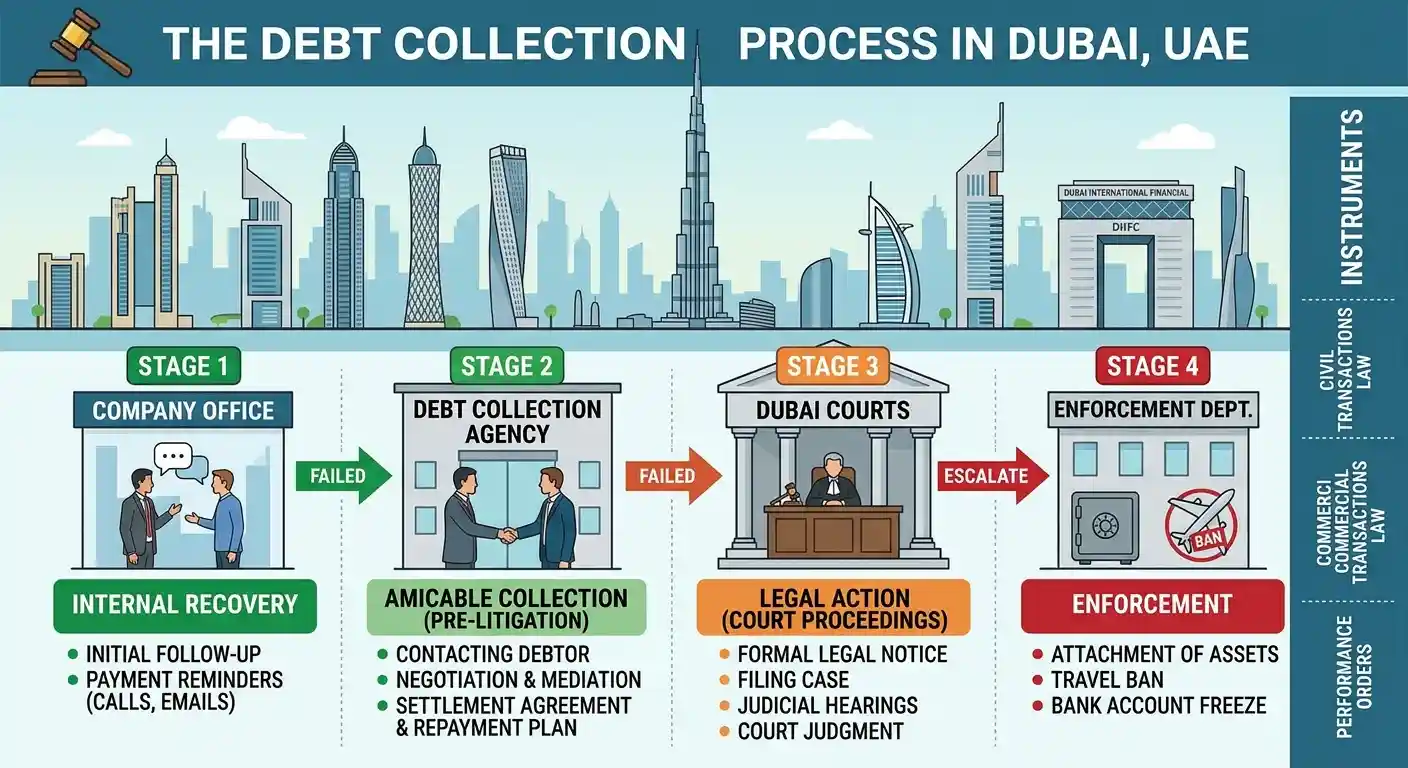
The debt collection process in Dubai involves several steps that help creditors recover outstanding payments from individuals, customers, and businesses that have failed to meet their financial obligations. Unpaid invoices, personal loans, commercial agreements, rental payments, and other contractual debts can create financial difficulties for creditors. Understanding the available recovery procedures can help creditors make informed decisions and protect their financial interests.
Debt collection Dubai services can assist individuals and businesses in recovering overdue payments through amicable negotiations, formal payment demands, legal proceedings, and enforcement procedures. The appropriate approach depends on the type of debt, the supporting evidence, the debtor’s response, and the applicable UAE laws.
1. Reviewing the Outstanding Debt
The first step in the debt collection process is to review the outstanding amount and establish the legal basis of the claim. Creditors should identify the original amount owed, the payment deadline, any payments already received, and the remaining balance.
Supporting documents may include signed contracts, invoices, purchase orders, delivery receipts, bank statements, and written communications acknowledging the debt. For commercial transactions, account statements and proof of goods delivered or services completed can also help establish the creditor’s position.
A thorough review allows creditors to determine whether the debt is due and whether the available evidence supports a potential recovery claim.

2. Contacting the Debtor
Before initiating formal proceedings, creditors often contact debtors to request payment and understand the reason for the delay. A debtor may be experiencing temporary financial difficulties, disputing an invoice, or simply overlooking a payment deadline.
Creditors can send written reminders by email or other appropriate communication channels. These reminders should identify the outstanding amount, explain the payment obligation, and specify a reasonable deadline for payment.
Maintaining a professional and documented communication history can be valuable if the matter later requires legal action. Debt collection communications should remain lawful, respectful, and consistent with applicable privacy and consumer protection requirements.
3. Sending a Formal Payment Demand
If informal reminders do not result in payment, the creditor may consider sending a formal demand notice. This document generally identifies the parties, explains the basis of the debt, states the outstanding amount, and requests payment within a specified period.
A formal notice can demonstrate that the creditor attempted to resolve the matter before pursuing further action. It may also be a procedural requirement for certain recovery routes.
For example, UAE civil procedure rules impose specific notice requirements for payment-order applications. The applicable requirements should be verified for the particular claim rather than assuming that every debt recovery case follows an identical process.
4. Attempting an Amicable Settlement
An amicable settlement may provide a practical alternative to litigation. During negotiations, creditors and debtors can discuss repayment arrangements that address the outstanding balance while considering the debtor’s financial circumstances.
Possible arrangements include payment in instalments, a mutually agreed settlement amount, or a revised payment schedule.
Any settlement should be documented clearly. The agreement should identify the parties, the amount payable, instalment dates where applicable, the consequences of default, and any agreed terms concerning the remaining balance.
A written agreement can reduce misunderstandings and provide evidence of the revised obligations if a dispute arises later.
5. Initiating Legal Proceedings
If the debtor refuses to pay and negotiations fail, the creditor may consider filing a claim before the competent court or other appropriate dispute-resolution forum.
The available procedure depends on the nature of the debt, the contractual arrangements, the parties involved, and the applicable jurisdiction. Some claims may qualify for a payment-order procedure, while others require ordinary proceedings.
The creditor may need to provide a statement of claim, supporting documents, evidence of the outstanding balance, and any documents required to establish the representative’s authority. Court fees and other procedural requirements may also apply.
Where an arbitration agreement governs the dispute, the creditor may need to pursue arbitration instead of commencing ordinary court proceedings on the merits, subject to the applicable law and circumstances.
6. Obtaining and Enforcing a Judgment
If the creditor succeeds in obtaining an enforceable judgment or order and the debtor does not comply voluntarily, enforcement proceedings may be available.
Depending on the applicable legal requirements and the circumstances, enforcement measures may include attachment of eligible assets or bank accounts and other legally authorized measures. The availability of any particular measure depends on the enforceable instrument, court orders, and applicable procedural rules.
Obtaining a judgment does not necessarily mean that payment will be immediate. Recovery can depend on whether the debtor has identifiable assets, whether those assets are legally available for enforcement, and whether other creditors have competing claims.
7. How Professional Debt Collection Services Can Help
Professional Debt collection Dubai services can help creditors organize documentation, communicate with debtors, negotiate settlements, and coordinate with legal professionals when formal proceedings become necessary.
Before appointing a provider, creditors should review its experience, contractual terms, fees, authority to act, and compliance practices. A debt collection agency’s authority is not the same as a lawyer’s authority to represent a client in court, and the appropriate professional should be engaged for the task concerned.
Conclusion
The debt collection process in Dubai generally begins with reviewing the debt and contacting the debtor. If payment remains outstanding, the creditor may issue a formal demand, negotiate a settlement, or pursue the appropriate legal procedure. Where an enforceable judgment or order is obtained, further enforcement steps may be available if the debtor still fails to pay.
By maintaining accurate records, understanding the applicable legal requirements, and choosing an appropriate recovery strategy, creditors can approach Debt collection Dubai matters more effectively. Because each case has different facts and procedural requirements, creditors should seek qualified legal advice when determining the most suitable course of action.

